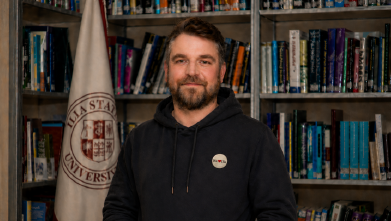
Tilmann Kulke

Direction: Global History
Position: Associate Professor

Tilmann Kulke is Associate Professor of Islamic and Global History at Ilia State University in Tbilisi. His research focuses on premodern intellectual history, Islamic texts, early modern global history, and the connected histories of the Mughal Empire, Georgia, and the Caucasus. He is especially interested in how texts, ideas, empires, and cultural spaces travelled, interacted, and transformed each other between the late medieval and early modern periods.

Since 2023, he has been working with colleagues at Ilia State University on a research project on enlightened tendencies, intellectual exchange, and structural reforms in Georgia during the seventeenth and eighteenth centuries — a fascinating field that opens new perspectives on Georgia’s place in early modern global history.

At Ilia State University, he teaches Global History, Islamic History, and International Relations since 1800, with a particular focus on perspectives from the Global South. One of the most meaningful parts of his work is supporting students: encouraging them to develop their own academic interests, apply for DAAD and international scholarships, and imagine wider intellectual and professional futures.

He studied Islamic Studies, Early Modern History, and Anglo-American History in Cologne, Bonn, Istanbul, Damascus, and Paris. In 2016, he defended his PhD at the European University Institute in Florence, in an academic environment shaped by Jorge Flores and Stephan Conermann. After working in the DAAD scholarship programme for Syrian refugee students, he moved with his family to Tbilisi.

Since his arrival in Georgia, he has also been closely connected to the Goethe-Institut. Teaching German, working with young people, and helping students gain confidence has become an important extension of his academic life. For him, scholarship and teaching belong together: both are ways of opening worlds, building bridges, and helping students discover their own voice.

Scientific interests / research interests
  • Premodern and Early Modern Intellectual History
  • Global and Connected History
  • Narratology and Historical Textuality
  • Islamic History and Culture
  • History of the Mughal Empire, Georgia, and the Caucasus
  • International History of the Middle East since 1800

Books


  • Tilmann Kulke: Katja Gloger and Georg Mascolo, Das Versagen: Eine investigative Geschichte der deutschen Russlandpolitik, Berlin: Ullstein, 2025, pp. 496, in: The Book Review, No 2 FEBRUARY 2026.
  • Tilmann Kulke: Carlo Masala, Wenn Russland gewinnt: Ein Szenario, München: C.H. Beck, 2025, pp. 119, in: The Book Review, No 2 FEBRUARY 2026.
  • Anna Kollatz, Tilmann Kulke, eds., Narrative Strategies for India in Transition, Berlin: EBV-Verlag, 2023.
  • Nino Doborjginidze, Oliver Reisner, Tilmann Kulke, Translation of Sebastian Conrad’s What is Global History?, Princeton: Princeton University Press, 2016 into Georgian: Sebast’ian K’onrad, Ra aris Globaluri Ist’oria?, Tbilisi: Ilias Universit’et’is Gamomtsemloba, 2023).
  • Tilmann Kulke, Anna Maria Vincente, eds., From Florence to Goa and Beyond. Essays in Early Modern Global History, Florence: European University Institute Press, 2022.

Special-Issues

  • Anna Kollatz / Tilmann Kulke: Aktuelle Studien zur Geschichte des Islams in Indien, in: sehepunkte 22 (2022), Nr. 4
  • Moritz von Brescius, Robrecht Declercq, Tilmann Kulke, James White, eds., Special Issue of Zeitenblicke: Current Historiograpical Research at the European University Insitute, in Zeitenblicke, 2013, Vol. 12, No. 1, Universität zu Köln, 2013.

Selected articles in edited volumes, journals and Encyclopedias

  • Anna Kollatz, Tilmann Kulke, Editors’ Preface: Narrative Strategies for India in Transition, in idem, eds., Narrative Strategies for India in Transition, Berlin: EBV-Verlag, 2023, 9-19.
  • Giorgi Kavtaradze, Tilmann Kulke, Luring the Tsar into India: Rafael Danibegashvili’s political narrative of transitional India, in Anna Kollatz, Tilmann Kulke, eds., Narrative Strategies for India in Transition, Berlin: EBV-Verlag, 2023, 107-155.
  • Anna Kollatz, Tilmann Kulke, Conclusion: Perspectives on India in Transition, in idem, eds., Narrative Strategies for India in Transition, Berlin: EBV-Verlag, 2023, 323 – 357.
  • Nino Doborjginidze, Oliver Reisner, Tilmann Kulke, Shesavali, in idem, transl., Sebast’ian K’onrad, Ra aris Globaluri Ist’oria?, Tbilisi: Ilias Universit’et’is Gamomtsemloba, 2023, 1-16.
  • Tilmann Kulke, Irene Mª Vicente Martín, eds., Prelude, in idem, eds. From Florence to Goa and Beyond. Essays in Early Modern Global History, Florence: European University Institute Press, 2023, 7-13.
  • Nino Doborjginidze, Tilmann Kulke, Erekle II. (1720-1798) goes global: Zwischen Aufklärung, Wissenstransfer und strukturellen Reformen in Georgien ab den 1750er Jahren, in Tilmann Kulke, Irene Mª Vicente Martín, eds., From Florence to Goa and Beyond. Essays in Early Modern Global History, Florence: European University Institute Press, 2023, 145-175.
  • Tilmann Kulke, Irene Mª Vicente Martín, Current historiographical research in early modern global history. An interview with Jorge Flores, in idem, eds. From Florence to Goa and Beyond. Essays in Early Modern Global History, Florence: European University Institute Press, 2023, 267-280.
  • Tilmann Kulke, Aurangzeb and Islam in India: 50 Years of Mughal Realpolitik, in Knut Jacobsen, ed., Routledge Handbook of South Asian Religions, Leiden: Brill, 2020, 190-205.
  • Tilmann Kulke: Muḥammad Kāẓim, in, Kate Fleet, Gudrun Krämer, Denis Matringe, John Nawas, and Everett Rowson, eds., Encyclopedia Islamica III., Leiden: Brill, 2020, 121-122.
  • Tilmann Kulke: Mustaʿidd Ḫān, in Kate Fleet, Gudrun Krämer, Denis Matringe, John Nawas, and Everett Rowson, eds., Encyclopedia Islamica III., Leiden: Brill, 2020, 144-145.
  • Tilmann Kulke: ʿInāyat Allāh Ḫān b. Mirza Šukr, in Kate Fleet, Gudrun Krämer, Denis Matringe, John Nawas, and Everett Rowson, eds., Encyclopedia Islamica III., Leiden: Brill, 2020, 47-48.
  • Moritz von Brescius,Tilmann Kulke, Interview über die Globalgeschichte mit Professor Sebastian Conrad, in in Zeitenblicke, 2013, Vol. 12, No. 1, Universität zu Köln, 2013.

Reviews:

  • Tilmann Kulke: Katja Gloger and Georg Mascolo, Das Versagen: Eine investigative Geschichte der deutschen Russlandpolitik, Berlin: Ullstein, 2025, pp. 496, in: The Book Review, No 2 FEBRUARY 2026.
  • Tilmann Kulke: Carlo Masala, Wenn Russland gewinnt: Ein Szenario, München: C.H. Beck, 2025, pp. 119, in: The Book Review, No 2 FEBRUARY 2026.
  • Tilmann Kulke: Ulrike Herrmann, Das Ende des Kapitalismus: Warum Wachstum und Klimaschutz nicht miteinander vereinbar sind - und wie wir in Zukunft Leben werden, Köln: Kiepenheuer & Witsch, 2022, pp. 352, in: The Book Review, No 3 MARCH 2023.
  • Tilmann Kulke: Stephan Conermann, Anna Kollatz, Macht bei Hofe. Narrative Darstellungen in ausgewählten Quellen. Ein interdisziplinärer Reader. Berlin: EB-Verlag, 2020, 265 pp., in: The Book Review, No 3, March 2022.
  • Tilmann Kulke: Eva Orthmann, Anna Kollatz, The Ceremonial of Audience. Transcultural Approaches, Bonn: Bonn University Press, 2022, in: The Book Review, No 4, April 2022.
  • Tilmann Kulke: Ariel I. Ahram, Break all the Borders Separatism and the Reshaping of the Middle East, New York: Cambridge University Press, 2019, in: Weltsichten, January 2020.
  • Tilmann Kulke: Stephen Dale, Babur: Timurid Prince and Mughal Emperor, 1483-1530, Cambridge: Cambridge University Press, 2019, in The Book Review, No 1, january 2021.
  • Tilmann Kulke: Fareen Parvez: Politicizing Islam. The Islamic revival in France and India, New York: Oxford University Press, in: Sehepunkte 21 (2020), 3 (eingereicht).
  • Tilmann Kulke: Prasannan Parthasarathi: Why Europe Grew Rich and Asia Did Not. Global Economic Divergence, 1600-1850, Cambridge: Cambridge University Press 2011, in: sehepunkte 19 (2019), Nr. 6 [15.06.2019]
  • Tilmann Kulke: Susanna Burghartz, Lucas Burkart, Christine Göttler: Sites of Mediation. Connected Histories of Places, Processes, and Objects in Europe and Beyond, 1450-1650, Leiden 2016, in: Schweizerische Zeitschrift für Geschichte, 69,1, 2019, 164–203.
  • Tilmann Kulke: Arundhati Roy: The Ministry of Utmost Happiness, London: Hamish Hamilton 2017, in: sehepunkte 18 (2018), Nr. 4 [15.04.2018]
  • Tilmann Kulke: Thomas Hegghammer (ed.): Jihadi Culture: The Art and Social Practices of Militant Islamists, Cambridge: Cambridge University Press 2017, in: sehepunkte 18 (2018), Nr. 4 [15.04.2018]
  • Tilmann Kulke: İhsan Oktan Anar: Galîz Kahraman, Akara: İletişim Vayιnlarι 2014, in: sehepunkte 14 (2014), Nr. 5 [15.05.2014]
  • Tilmann Kulke: Ayşen Anadol, Zeynep Avcı, Nazan Ölçer et al.: Louvre Koleksiyonlarından Başyapıtlarla İslam Sanatının 3 Başkenti İstanbul, Isfahan, Delhi, Istanbul: Sabancı Üniversitesi 2008, in: sehepunkte 13 (2013), Nr. 11 [15.11.2013]
  • Tilmann Kulke: Muzaffar Alam, Sanjay Subrahmanyam (eds.): Writing the Mughal World. Studies on Culture and Politics, New York: Columbia University Press 2011, in: sehepunkte13 (2013), Nr. 7, 8 [15.07.2013]
  • Tilmann Kulke: Kumkum Chatterjee: The Cultures of History in Early Modern India. Persianization and Mughal Culture in Bengal, Oxford: Oxford University Press 2009, in: sehepunkte 13 (2013), Nr. 7,8 [15.07.2013]
  • Tilmann Kulke: Manning Marable: Malcolm X. A Life of Reinvention, New York: Penguin Press 2011, in: sehepunkte 12 (2012), Nr. 10 [15.10.2012]
  • Tilmann Kulke: Jeffrey B. Perry: Hubert Harrison. The Voice of Harlem Radicalism, 1883-1918, New York: Columbia University Press 2009, in: sehepunkte 12 (2012), Nr. 9 [15.09.2012]
  • Tilmann Kulke: David O. Morgan, Anthony Reid (eds.): The Eastern Islamic World. Eleventh to Eighteenth Centuries, Cambridge: Cambridge University Press 2010, in: sehepunkte 12 (2012), Nr. 7,8 [15.07.2012]
  • Tilmann Kulke: Musharraf Ali Farooqi: The Adventures of Amir Hamza, New York: Random House 2008, in: sehepunkte 11 (2011), Nr. 10 [15.10.2011]
  • Tilmann Kulke: Nader Purnaqcheband: Strategien der Kontigenzbewältigung. Der Mogulherrscher Humāyūn (r. 1530-1540 und 1555-1556) dargestellt in seiner “Taẕkirat al-Wāqiʿāt” seines Leibdieners Jauhar Aftābčī, in: sehepunkte 11 (2011), Nr. 6 [15.06.2011]
  • Tilmann Kulke: Sönke Finnern: Narratologie und biblische Exegese, Tübingen 2010, in: sehepunkte 11 (2010), Nr.6 [15.06.2011]
  • Tilmann Kulke: Klaus Kreiser: Istanbul. Ein historischer Stadtführer, 2., durchgesehene Auflage, München: C.H.Beck 2009, in: sehepunkte 10 (2010), Nr. 11 [15.11.2010]
  • Tilmann Kulke: Geert Mak: Die Brücke von Istanbul. Eine Reise zwischen Orient und Okzident. Aus d. Niederländischen v. Andreas Ecke, 2. Aufl., New York: Pantheon Books 2007, in: sehepunkte 10 (2010), Nr. 1 [15.01.2010]
  • Tilmann Kulke: Peter Feldbauer, Jean-Paul Lehners (Hgg.): Die Welt im 16. Jahrhundert, Wien: Mandelbaum 2008, in: sehepunkte 10 (2010), Nr. 1 [15.01.2010]
  • Tilmann Kulke: John Darwin: After Tamerlane. The Global History of Empire, London: Penguin Books 2007, in: sehepunkte 9 (2009), Nr. 10 [15.10.2009]
  • Tilmann Kulke: Sanjay Subrahmanyam: Explorations in Connected History. From the Tagus to the Ganges, Oxford: Oxford University Press 2005, in: sehepunkte 9 (2009), Nr. 10 [15.10.2009]
  • Tilmann Kulke: Reza Aslan: Kein Gott außer Gott. Der Glaube der Muslime von Muhammad bis zur Gegenwart. Aus dem Englischen von Rita Seuß, München: C.H.Beck 2006, in: sehepunkte 9 (2009), Nr. 6 [15.06.2009]
  • Tilmann Kulke: Sanjay Subrahmanyam: Explorations in Connected History. Mughals and Franks, Oxford: Oxford University Press 2005, in: sehepunkte 9 (2009), Nr. 1 [15.01.2009]

Current Courses

Understanding Global History (ENG); History, Politics, and Culture of Islam; A Global History of the 19th-Century. The Transformation of the World(ENG)

The Global History from 1914 until 2000; Understanding Global History (ENG); Understanding Islam. History, Politics and Culture (ENG)

Course Catalog

  • Global and Transnational History. An Introduction (Master, Spring Semester 2017-Spring Semester 2020)
  • Islam in Europe. Historical and Contemporary Dimensions (Master, Spring Semester 2017-Spring Semester 2020).
  • Lessons of the Revolution. The Arab Spring in Global Context (Master, Spring Semester 2017-Spring Semester 2020)